Meta Ads
What B2B Ad Creative Works on Instagram in 2026?
B2B ad creative works on Instagram when it looks native to the feed: product UI with real numbers, founder video, single-stat posts and customer-voice message threads, built to Instagram's own aspect ratios and safe zones. Repurposed LinkedIn copy, dense screenshots and gated whitepapers score poorly because the feed rewards clarity in two seconds, not professional polish.
Key takeaways
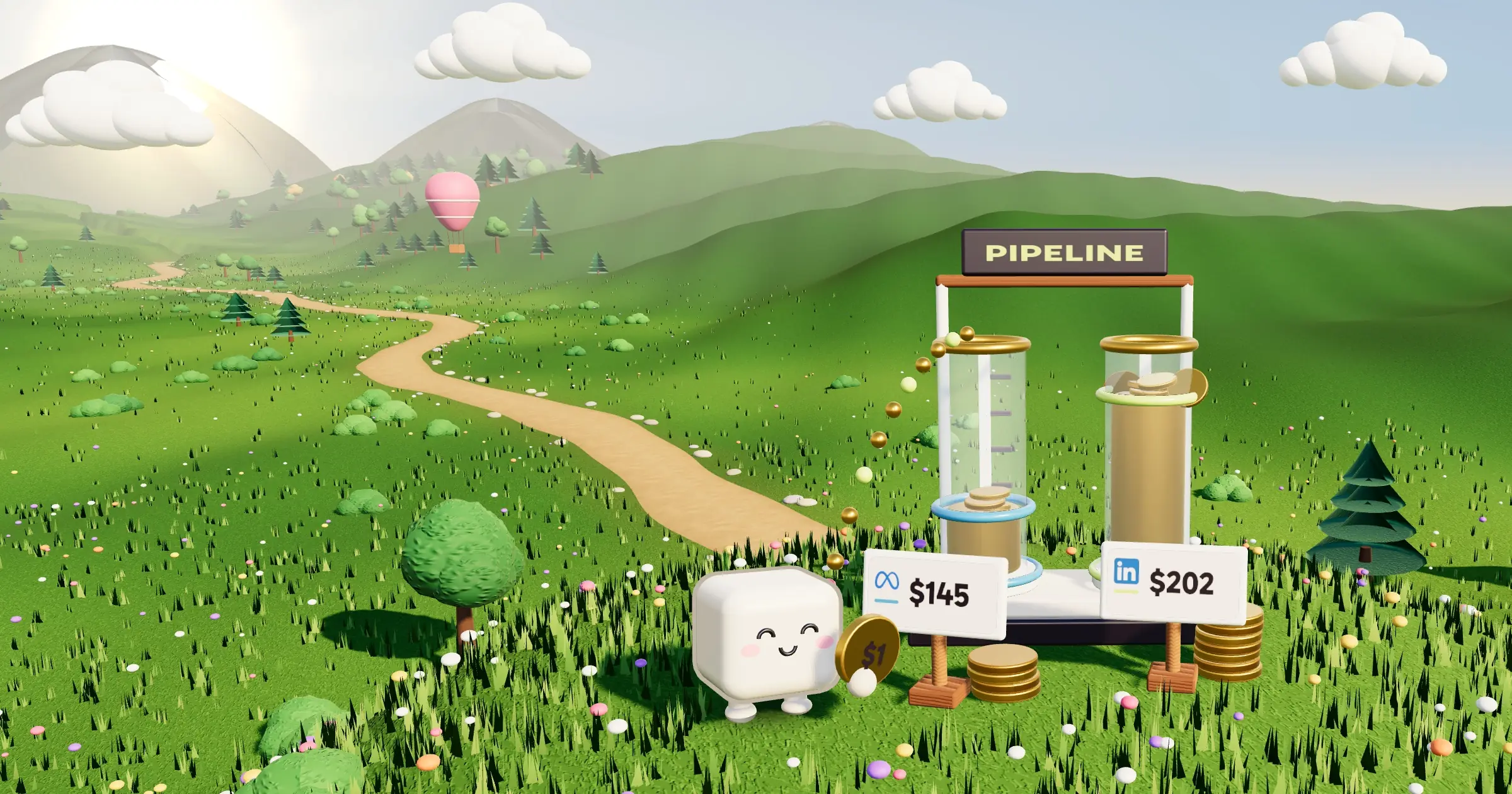
- Facebook and Instagram ads do work for B2B: in 2025 they cost $145 and $138 per lead against $202 on LinkedIn, but Facebook clicks convert to leads at roughly half LinkedIn's rate, so the economics mostly cancel out.
- Instagram's safe zones (top 14%, bottom 35%, sides 6% on 9:16 placements) and a 44-character copy limit on Reels mean creative built for LinkedIn gets clipped and overwritten when stretched to fit.
- Native-feeling patterns, product UI with real numbers, familiar artifacts rewritten, customer message threads, single-stat editorial posts, score highest in analyses of thousands of B2B Meta ad creatives.
- Brand vision statements and creative with no visible brand score well below average in one library of B2B Meta ads, while 94% of top-rated creatives make their point within two seconds.
- Treat Instagram as a reach and retargeting layer measured by influenced pipeline and incrementality tests, not as a last-click lead channel judged on cost per lead alone.
Facebook and Instagram ads work for B2B, but only under specific conditions, and only with creative built for a feed that was never designed to look professional. In 2025, 71 B2B advertisers paid $145 per lead on Facebook and 49 paid $138 on Instagram, against $202 on LinkedIn, across $57.6M of spend from 153 advertisers, according to Metadata's 2026 B2B Paid Media Benchmark. The catch: Facebook clicks converted to leads at 2.6%, against 5.9% on LinkedIn, so the cheaper click buys a less qualified one, and the two effects roughly cancel on cost per lead.
Instagram is rarely the channel that closes a B2B deal on last click. It keeps a brand in front of a buying committee between the moments they're actively searching, cheap enough to run as a retargeting and reach layer alongside LinkedIn and Google. Get the role right, and the creative question gets easier to answer.
Do Facebook and Instagram ads work for B2B, and for which offers?
Meta works best for B2B products a person can buy or try on their own, and for retargeting people who already know the brand, according to Understory Agency's analysis of 4,741 B2B creatives pulled from Meta's public Ad Library. That matches the cost data: on Facebook, retargeting cost $120 per lead in 2025 against $166 for cold prospecting, per Metadata's benchmark. LinkedIn runs the opposite way, retargeting there cost $234 against $194 for prospecting, likely because LinkedIn's warm pools are small and already saturated with the advertiser's own creative. The efficient split for teams running both is the one most have backwards: cold prospecting on LinkedIn, warm retargeting on Meta.
Directive Consulting's B2B Instagram guide makes the audience case plainly: Instagram reaches executives, practitioners and other buying-committee members well before they become identifiable demand. That reach matters because LinkedIn's professional-attribute targeting is more precise, but it mostly catches people once they're already visible as prospects; Instagram adds reach and frequency outside the work-mode moments LinkedIn owns.
Format matters for cost, too. Static image ads cost $136 per lead on Facebook in 2025 against $225 for video, a 40% gap, and the same pattern held on LinkedIn, where document ads beat image and video, according to Metadata. Video earns its spot when the job is explaining something a static frame can't, not as the default lead-generation unit.
| Channel | Advertisers (n) | CTR | CPC | CPM | Click to lead | Cost per lead |
|---|---|---|---|---|---|---|
| 71 | 0.79% | $1.95 | $15.50 | 2.6% | $145 | |
| 49 | 0.65% | $2.82 | $18.25 | 4.0% | $138 | |
| 138 | 0.67% | $9.39 | $63.19 | 5.9% | $202 | |
| Google Ads | 56 | 6.33% | $9.76 | $617.91 | 1.9% | $524 |
Source: Metadata 2026 B2B Paid Media Benchmark, calendar-2025 campaigns. Google Ads is a search channel, so its CTR and CPM aren't directly comparable to social, it's included because it's the other place the same budget competes.
Tofu Ads Agent treats Meta, Facebook and Instagram as a live channel alongside LinkedIn and Google, building the audience, creative and campaign the same way, and staging everything into your own ad account switched off until a person approves it.
What format specs does Instagram actually require?
Instagram punishes creative built for another placement's dimensions before anyone reads the copy. Meta's Ads Guide recommends 4:5 at 1440 x 1800 pixels for Feed and 9:16 at 1440 x 2560 pixels for Stories and Reels, and applies an aspect-ratio tolerance of just 1% on Instagram, so a file that's nearly 4:5 passes on Facebook and crops oddly on Instagram, according to Kive's spec breakdown of Meta's documentation.
Every 9:16 placement also carries a safe zone Meta's own interface will cover: roughly the top 14%, the bottom 35% and 6% on each side are reserved for the profile icon and CTA button, per the same source. A Reels ad carrying a disclaimer needs the bottom 40% clear instead of 35%. That's exactly where a repurposed LinkedIn document ad, built for a static 4:5 or 1:1 frame with the headline near the bottom, gets clipped when someone stretches it to 9:16.
| Placement | Ratio | Recommended size | Primary text / headline limit |
|---|---|---|---|
| Instagram Feed | 4:5 (1:1 supported) | 1440 x 1800 px | 125 / 40 characters |
| Instagram Stories | 9:16 | 1440 x 2560 px | 125 characters, no headline field |
| Instagram Reels | 9:16 | 1440 x 2560 px | 44 characters, no headline field |
| Carousel | one consistent ratio across every card | matches Feed or Stories spec | same per-card limits as the chosen placement |
Source: Kive, Meta Ad Sizes 2026, citing Meta's Ads Guide and Business Help Center pages.
Reels carries the tightest copy limit of any Instagram placement, 44 characters of primary text and no headline field. A LinkedIn carousel caption running two sentences has nowhere to go here. Design the Reels version first, inside its safe zone and character limit, then adapt up to Feed, not the other way around.
What creative patterns actually work for B2B on Instagram
Across 4,741 distinct B2B creatives from 169 advertisers pulled from Meta's Ad Library, 94% of the top-rated ads got their point across in two seconds, against 75% of all creatives, according to Understory's analysis. In a feed built for photos of friends and family, clarity has to happen before anyone decides to keep scrolling. The same analysis found single-image ads scored 4.8 out of 10 on average, the highest of any format, while video scored lowest at 3.6 (largely because the scoring model judges a video by its cover frame). A handful of patterns repeat across the highest-scoring, longest-running ads:
- Product UI with real numbers. One cropped, believable product screen or alert with exact, non-round figures and a timestamp. The specificity is the proof, not a design flourish.
- Familiar artifact, rewritten. Recreate a document the buyer handles every week, an invoice, a renewal dialog, a calendar invite, and change one line so it makes the argument.
- Overheard message thread. A Slack or iMessage-style screen with 3 to 5 short messages that voice the buyer's pain in their own words.
- Named customer as hero. A real customer's product, exec or outcome fills the frame while the advertiser's logo sits small beside it.
- Editorial data page (the single-stat post). One real chart or newspaper-style layout with at most three stats and a cited source and sample size.
- Typographic sting. Pure type on a flat color: a setup line, then a short, sharp line about what the best companies do differently.
Founder and employee video fits the same logic, even though it isn't one of Understory's named patterns: a person talking into a phone camera, not a studio set. Digital Applied's Reels guide argues that native-style creative, handheld camera, natural light, lo-fi editing, consistently beats polished production on completion rate, because the feed rewards content that looks like it belongs rather than an ad that interrupts it. Treat a founder narrating a customer problem, or an engineer walking through a product UI in motion, as the moving, spoken version of the "product UI with real numbers" and "overheard message thread" patterns above.
What fails: repurposed LinkedIn creative and other feed mismatches
Three creative choices scored well below the library average in Understory's analysis of the 4,741 ads: 3D shapes, gradients or abstract art averaged 3.3 out of 10 against a 4.2 library average; a brand statement or vision line as the hook averaged 3.6 against 4.2; and creative with no brand visible in the frame averaged 3.3, against 4.6 when the brand was visible. On a feed where your ad sits between someone's vacation photos, people need to see who sent it before they'll process what it says.
A few other formats fail for reasons you can reason through directly, even without a score attached. Dense screenshots built for a desktop LinkedIn feed shrink to illegible text on a 1440 x 2560 phone canvas. Logo walls and "trusted by" grids ask for a credibility check nobody performs mid-scroll between friends' posts. Gated whitepapers trade an email for a PDF, an exchange a LinkedIn user half-expects and an Instagram user doesn't; route that offer to a landing page link instead of a native lead form. And LinkedIn copy pasted straight into a vertical frame keeps the headline near the bottom of the image, exactly where Instagram's safe zone and CTA button live.
How to test enough variations without a designer
The patterns above are a starting list, not a one-time build. Understory's own guidance is to treat each pattern as a test, run it against your current best ad for 2 to 3 weeks, and judge it on the campaign's own metric rather than vanity engagement. That takes enough variations in flight to actually learn something, which is where most lean B2B teams stall: one designer, one brand kit, a backlog that never clears.
The fix isn't more hours from the same designer, it's more variations from the same brand assets. Build templates once, in the brand's real fonts, colors and logo, with every line, crop and CTA as an editable layer, then swap in a new hook or proof point without a new design cycle per ad. That's the approach covered in how to produce ad creative without a designer, and it's also how Tofu Ads Agent builds creative: using a customer's real fonts, colors, logos and approved templates, with every element editable, to produce enough variations to actually run the pattern tests above instead of picking one and hoping.
A practical minimum: one concept per pattern, per priority audience segment, refreshed every 2 to 3 weeks on whichever ad set carries spend. Two creatives running side by side for a month isn't a test, it's a coin flip with extra steps.
How to measure Instagram's contribution when it isn't the last click
Instagram's job in a coordinated B2B media plan is usually reach and retargeting, not last-click lead generation, so judging it by cost per lead alone will make it look worse than it is and better than it is in the same quarter. Directive's framework separates delivery metrics, reach, frequency, click-through rate, cost per click, which diagnose where friction lives, from value metrics that actually reach revenue: sales acceptance, cost per opportunity, influenced pipeline and blended CAC across the paid program.
Because attribution can't settle every question on its own, the same guide recommends incrementality checks for the hard ones. A holdout keeps a group deliberately out of the Instagram audience so you can compare their behavior to people who did see ads. A geo test turns spend on in some regions and off in others, reading the lift Instagram actually caused rather than the conversions it merely touched. Set a source-of-truth hierarchy up front, Meta, your analytics, your CRM and finance will each report a different number, so decide in advance which system answers which question.
Don't skip the CRM connection, either. Of 132 B2B advertisers running lead-generation campaigns through Metadata in 2025, 42 had no CRM opportunity signal at all, meaning the platform never learned which cheap leads actually became revenue, according to Metadata's benchmark report. A cheap Instagram lead is only a good story if you can trace what it became. For the mechanics of running Instagram and Meta as a supporting layer rather than a standalone funnel, see running B2B Meta ads alongside LinkedIn and Google.
Frequently asked questions
Do Facebook and Instagram ads actually work for B2B marketing?
Yes, measurably: 71 B2B advertisers paid $145 per lead on Facebook and 49 paid $138 on Instagram in 2025, against $202 on LinkedIn, according to Metadata's benchmark report. The clicks convert at a lower rate than LinkedIn, so the gain shows up as cheaper reach and retargeting, not automatically as cheaper customers.
Is Instagram better than Facebook for B2B ads?
Instagram bought a slightly cheaper lead in 2025, $138 against $145 on Facebook, and converted more of its clicks, 4.0% against 2.6%, while Facebook had the cheaper click and CPM, per Metadata. Neither wins outright; if you already buy Facebook placements, there's no data-based reason to exclude Instagram from the same budget.
What's the biggest mistake teams make with B2B Instagram creative?
Repurposing a LinkedIn ad instead of designing for Instagram's own aspect ratios and safe zones. A headline sized for a 4:5 LinkedIn carousel lands in the bottom 35% of a 9:16 Instagram Reels frame, exactly where Meta's profile icon and CTA button sit, according to Kive's breakdown of Meta's spec pages.
Should B2B Instagram video be polished or native-looking?
Native-looking generally wins. Digital Applied's Reels guide argues handheld, natural-light, lo-fi video consistently outperforms studio production on completion rate because it looks like it belongs in the feed. Save studio polish for formats like named-customer case studies where production value signals credibility.
How many ad creative variations do you need to test on Instagram?
Enough to run each pattern, product UI, customer message thread, single-stat post, and so on, against at least one priority audience for 2 to 3 weeks before judging it, per Understory's testing guidance. Two creatives running for a month isn't a test; it's a guess with a budget attached.
How should B2B teams measure Instagram's impact if it rarely gets the last click?
Judge delivery metrics like CTR and CPC as diagnostics, and judge the channel itself on sales acceptance, cost per opportunity and influenced pipeline, using holdout or geo tests to confirm incremental lift, per Directive Consulting's measurement framework. Cost per lead alone will misjudge a channel that's doing its job as reach and retargeting.
Do gated whitepapers work as an Instagram offer for B2B?
They generally underperform. An email-for-PDF exchange fits the expectations of a professional feed like LinkedIn more than an entertainment feed like Instagram. A lighter offer routed to a landing page, or a native lead form for a low-context ask, tends to fit buyer intent on Instagram better than a gated asset.
Sources
- Meta Ads for B2B: What Facebook and Instagram Actually Deliver, From $57.6M of 2025 Spend · Metadata.io
- B2B Facebook and Instagram Ad Examples, Scored · Understory Agency
- B2B Instagram Ads: The Complete Guide To Pipeline · Directive Consulting
- Meta Ad Sizes 2026: Feed, Stories, Reels Specs and Safe Zones · Kive
- Instagram Reels Ads 2026: Creative Strategy Guide · Digital Applied